
Product photography is one of the most technically demanding disciplines in the industry. The gap between an image that sells and one that doesn’t often comes down to the environment it was captured in — which makes choosing the right photography studio for hire in Melbourne one of the most important decisions you’ll make before a shoot.
Whether you’re a brand shooting an e-commerce catalogue, a photographer taking on a commercial client, or a content creator producing social imagery, this guide covers everything you need from a studio space to produce sharp, consistent, conversion-ready product work.
Why the Studio Environment Matters More for Product Photography
Unlike portraiture or lifestyle shoots, product photography leaves nowhere to hide. Backgrounds, shadows, reflections, and colour accuracy are all directly shaped by the space you’re working in. A studio that works beautifully for a fashion editorial may be completely unsuitable for flat lay product work or hero shots that require controlled directional lighting.
The specific demands of product photography mean you need to evaluate studios differently — not just on aesthetic appeal, but on their technical suitability for precise, repeatable results.

1. Lighting Control: Precision Over Atmosphere
For product work, lighting is everything. You need the ability to control it absolutely — not just dial in a mood, but eliminate variables between frames and across an entire shoot day.
What to look for:
Blackout capability
Natural light is beautiful, but inconsistent. For product shoots where colour accuracy and consistency are non-negotiable — think hero shots, white-background e-commerce, reflective surfaces — you need full blackout control. Studios with motorised blinds or blackout shutter systems give you the flexibility to use natural light when it suits and eliminate it entirely when it doesn’t.
Strobe compatibility
Most serious product photography relies on strobe lighting for its precision, repeatability, and power. Confirm the studio has adequate power outlets, appropriate ceiling rigs, and no restrictions on strobe use.
Diffused light sources
Softboxes, beauty dishes, and diffusion panels are standard tools for product work. Studios that provide these — or at minimum offer stable mounting infrastructure — save significant setup time.
No colour contamination
Brightly coloured feature walls, coloured flooring, or reflective surfaces nearby can throw unwanted colour casts onto products. Neutral-tone studios (white, grey, black) are the gold standard for product work.
2. Backgrounds and Surfaces: Consistency Across a Full Catalogue
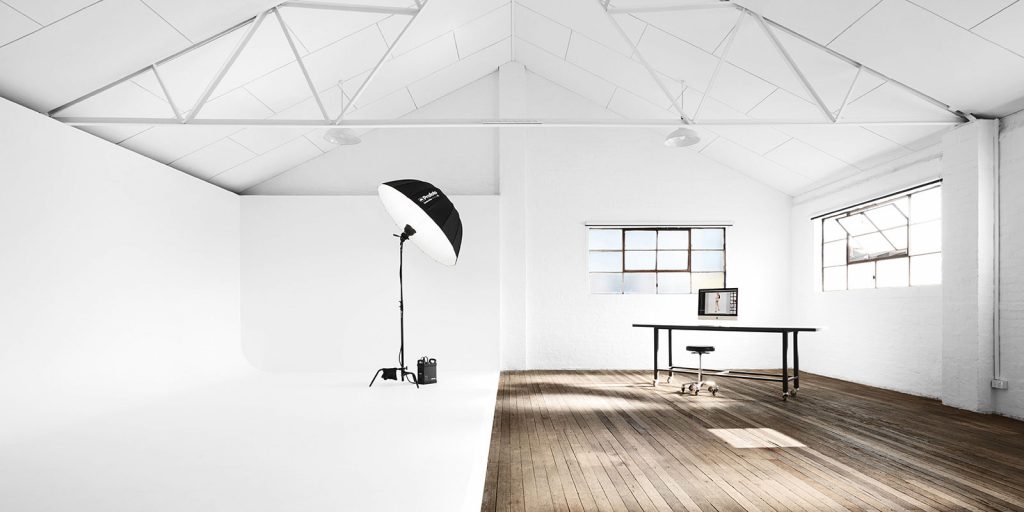
Shooting a product catalogue means producing consistent imagery across dozens — sometimes hundreds — of individual items. The backgrounds and shooting surfaces you have access to directly affect your efficiency and the cohesion of the final deliverable.
Seamless paper rolls
The industry standard for clean, shadowless product backgrounds. Look for studios that stock white, grey, and black seamless as a minimum, and can source additional colourways on request.
Flat lay surfaces
For overhead product shooting, the quality of tabletop surfaces matters. Marble-effect, timber, concrete, and matte solid-colour surfaces are all commonly requested. Studios that maintain a prop and surface library save you significant hire costs and shoot-day logistics.
Background stands and mounting systems
A properly rigged background system makes swapping between options fast. Flimsy stands that move between frames create problems in post. Check that background systems are robust and properly weighted.
3. Space Configuration: Room to Build the Shot
Product photography setups range from minimal (a table, a backdrop, one light) to complex (full environmental sets with multiple surfaces and props). The studio you choose needs to accommodate your most demanding configuration without compromise.
Table height and depth
Shooting surfaces at the right height reduce strain over a long shoot day and give you correct working angles for different product categories. Studios with adjustable-height tables or flat lay shooting platforms are a meaningful operational advantage.
Floor-to-ceiling clearance
Overhead rigs for flat lay work require vertical clearance. For large-format products — furniture, appliances, large props — you need both height and depth in the shooting area.
Separation of prep and shooting zones
A clean divide between your shooting area and your styling or product prep area means you can steam, arrange, and style without disturbing your background setup. Studios that combine these into a single room create ongoing friction throughout the day.
4. Support Infrastructure: The Details That Affect Your Day Rate
The supporting infrastructure of a studio — the things that don’t directly appear in your images — have an outsized impact on how productive your shoot day actually is.
- Power access — Strobe setups and continuous lighting can draw significant power. Confirm available circuits and outlet positioning before you book, particularly for larger setups.
- Steamer and iron access — Wrinkled fabrics on or around products are a constant problem. Studios that provide a garment steamer save you one thing to remember on pack-in.
- Trolleys and storage — Large product shoots involve significant physical logistics. Trolleys for moving product, secure storage for items between setups, and accessible shelving all contribute to a smoother day.
- Air conditioning — Heat from continuous lighting rigs in an un-air-conditioned space creates problems with products (particularly food, candles, anything with a surface that responds to heat) and with talent if your shoot involves models interacting with product.
5. Location and Access: The Logistics of Getting Product There
Product shoots often involve significant freight — flat-packed items, delicate goods, large props, or multiple deliveries from suppliers. The studio’s location and access arrangements directly affect your pre-shoot logistics.
In Melbourne, inner-suburb studios — Richmond, Collingwood, Fitzroy, South Melbourne — generally offer the best combination of accessibility, courier access, and proximity to stylists, prop hire suppliers, and post-production services.
Confirm:
- Loading bay or ground-level access for large or fragile deliveries
- Parking adjacent to the studio for vehicles you’re packing in and out of
- Courier delivery acceptance if product is being sent directly to the studio
6. How to Maximise Efficiency on Shoot Day
Booking the right studio is step one. Getting maximum value from your hired time is step two. A few principles that experienced product photographers rely on:
- Shot list before you arrive — Every product catalogued, every background variation planned, every lighting setup mapped. Arriving without a shot list turns a six-hour studio hire into an eight-hour one.
- Pre-light before product arrives — If you can access the studio in advance, even briefly, dialling in your lighting before product is on set saves significant hired time.
- Batch by setup, not by product — Group all products that use the same background and lighting configuration together. Changing setups between products, rather than batching, is the single biggest time drain in product shoots.
- Build in contingency — Always book one buffer hour. Products arrive damaged, setups take longer than expected, clients change their minds. A buffer hour is rarely wasted.
Why Ripe Studios Works for Product Photography
Ripe Studios in Richmond is purpose-built for professional photography, with the lighting control, neutral finishes, and thoughtful infrastructure that product shoots specifically demand.
Our studio offers controllable natural light alongside strobe-ready setups, neutral backgrounds, and the kind of well-maintained, detail-oriented environment that lets you focus on the work. We’re designed for photographers and brands who don’t want to waste time problem-solving a space.
See the studio and check availability — Book your session at Ripe Studios
Ripe Studios is a boutique photography studio for hire in Richmond, Melbourne — designed for commercial photographers, content creators, and brands who take quality seriously.
